
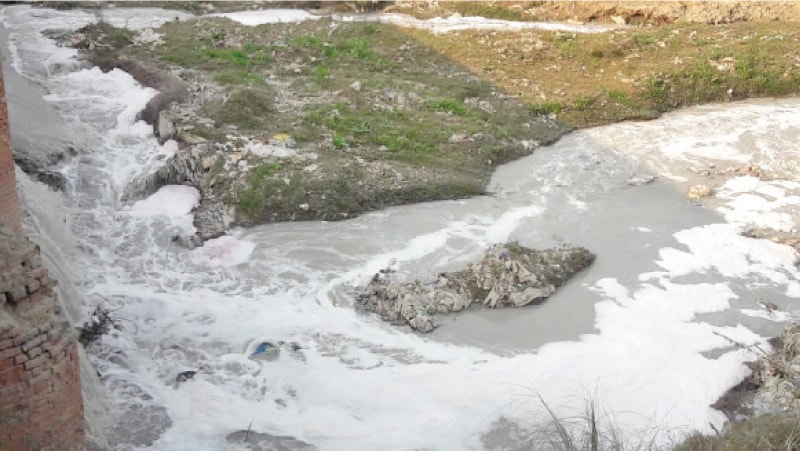
PESHAWAR—The issue of marble factories’ pollution in Peshawar has resurfaced with renewed urgency after the district administration decided to relocate the units to the Industrial Estate in Mohmand. Officials said that toxic wastewater and unchecked emissions from marble factories operating along Warsak Road continue to pose serious risks to public health and agriculture.
Officials confirmed during a meeting chaired by the deputy commissioner of Peshawar that these units discharge hazardous waste into vital irrigation channels. Consequently, authorities reviewed relocation options to Industrial Park Peshawar and the Mulagori Marble Cluster in Mohmand to mitigate the ongoing degradation of air and water quality across surrounding areas.
Also Read: Peshawar’s Pollution Crisis: Can Artificial Rain Be The Answer?
Environmental Crisis and Relocation Plan
The deputy commissioner expressed strong displeasure over the continuous absence of the director general of industries and the failure to provide updated data on marble units. Specifically, the administration lacks verified figures on the total number of factories, land requirements, and available plots. The DC warned that authorities cannot advance the relocation plan without these verified figures.
Current administrative data highlights a significant gap in available infrastructure:
- Industrial Park Peshawar: This site currently offers 271 plots covering 395 kanals. However, authorities require an additional 810 kanals to relocate all existing marble units.
- Mulagori Marble Cluster: This area provides approximately 105 acres with capacity for 100 additional units. However, the land remains under local ownership and requires complex negotiations with community elders.
Also Read: How Peshawar’s Canal System Became a Toxic Trap
The director general of the Environmental Protection Agency confirmed that the Mulagori Marble Cluster lacks a water treatment plant and filtration systems. This deficiency allows marble waste to flow directly into irrigation canals. As this polluted water travels from the Khyber district toward the city, it worsens marble factories’ pollution in Peshawar and poses serious risks to human health and provincial farming systems.
Industry Concerns and Final Decision Timeline
During a separate implementation committee meeting, officials stated that marble units operating on Warsak Road violate environmental laws. These factories function in areas where the approved land use plan does not permit marble processing.
While the administration offered two relocation options near Matani and the Mulagori Cluster, the Marble Association raised significant economic concerns.
Association representatives, including President Himmat Shah and General Secretary Zafar Khan Kundi, highlighted the following challenges:
- Historical Context: The industry has operated since 1975 and supports thousands of families.
- Logistical Costs: Relocation would increase transport distances from 70 kilometers to 150 kilometers, raising costs and creating challenges for workers’ mobility.
- Alternative Proposal: The association demanded that authorities allow operations at the current site and instead provide government support to improve environmental compliance measures.
Also Read: Plastic Pollution in Pakistan: An Escalating Environmental Threat
During the meeting, it was decided that the Marble Association will complete internal consultations immediately after Eidul-Fitr. The association must then submit a final response on relocation options. As marble factories pollute Peshawar, it remains a growing environmental and governance challenge; the Industries Department must immediately complete a fresh survey to protect the city’s environment.