
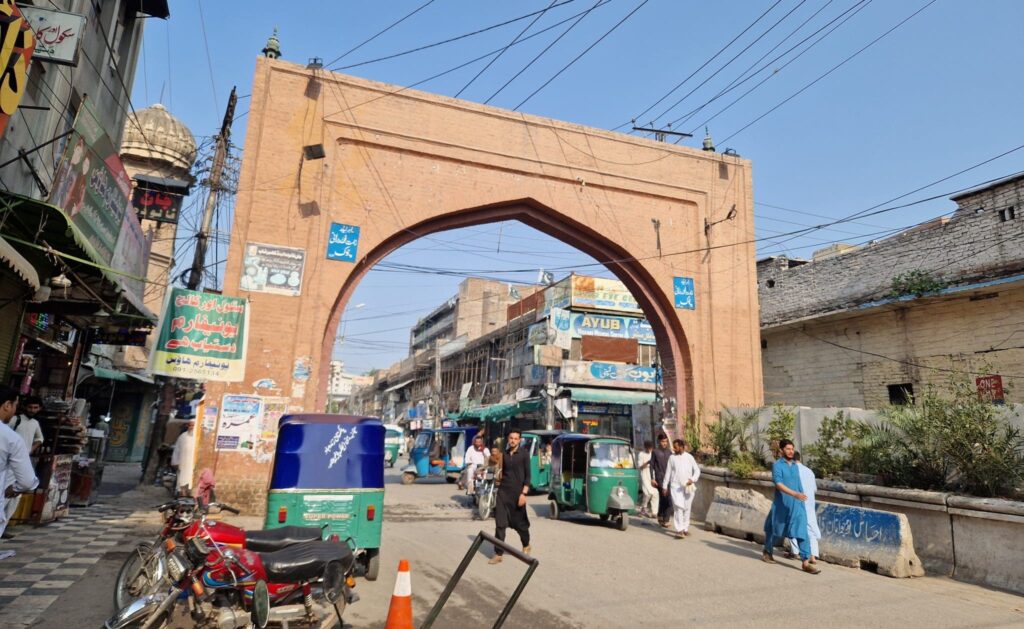
PESHAWAR — Imagine a place where ancient kings marched, silk traders bargained for fortunes, and centuries of history passed through a single set of wooden doors. For generations, the Walled City of Peshawar gates acted as the ultimate thresholds between the wild tribal roads of Afghanistan and the legendary wealth of old India.
Today, the massive brick walls that once protected the city have vanished under modern concrete, leaving these sixteen historic gateways as the very last puzzle pieces of a time when Peshawar was the busiest marketplace in Central Asia.
But these historic monuments are in deep trouble. As the modern city grows at a rapid pace, local developers and commercial greed are quietly tearing down or crowding out these beautiful landmarks. Saving what is left of the Walled City of Peshawar gates isn’t just about preserving old stone; it is an urgent rescue mission to save the heart and soul of a legendary city before its incredible stories are lost to the world forever.
Portals of Empire: The Grand Northern and Eastern Approaches
The Gateway to Kabul
The Kabli Gate stands as the definitive starting point for any historical exploration of the city. During the British Raj, colonial administrators attempted to stamp their authority on the structure, renaming it Edwardes Gate. However, local citizens fiercely rejected the imperial nomenclature, stubbornly restoring the name Kabli to honor the ancient highway pointing directly toward Afghanistan.
Passing through this portal leads directly into the sensory overload of the Qissa Khwani Bazar (The Market of Storytellers). Here, merchant caravans from Persia, India, and Central Asia historically gathered. Over green tea, travelers from entirely different worlds traded tales of the road, establishing the area as the region’s premier oral archive.
The Highway to the Punjab
On the eastern perimeter, the Lahori Gate functioned as the primary reception point for commercial traffic traveling from Punjab and Delhi. This sector historically attracted a dense, permanently settled Muslim population that managed the incoming trade from the fertile Indian plains.
The Convergence of Eight Towns
Further north lies the Hashtnagri Gate. The name combines the Persian Hasht (eight) and the Sanskrit Nagari (settlement or city). Authorities named the structure to reflect its strategic design: the radial routes emerging from this specific portal connected the urban core to eight prosperous regional towns in the valley.
Clashing Faiths and Ancient Legends along the Southern Rim
| Gate Name | Era of Origin | Cultural / Spiritual Significance |
| Asamai Gate | Ancient Hindu / Buddhist | Commemorates a deeply pious woman |
| Surki Gate | Zoroastrian / Pre-Islamic | Ancient site of dawn fire-worship |
| Sard Chah Gate | Buddhist / Mughal | Features a historic carved well |
The Memorial to Pious Devotion
The Asamai Gate preserves the memory of the city’s pre-Islamic multi-faith fabric. Named after an ancient Hindu temple, local lore credits its construction to Shio Maharaj, a devotee who built the sanctuary to memorialize his deeply spiritual wife. When the Chinese Buddhist pilgrim Xuanzang (Hiuen Tsang) traveled through Peshawar in antiquity, he documented this active temple complex, which stands adjacent to the historic Sarafa Bazar.
The Remnants of Fire-Worship
The Surki Gate—originally pronounced Sharki, meaning Eastern—served as the baseline for local cartography. Long before the arrival of Islam, the area hosted an active community focused on fire worship. Devotees exited through this gate early each morning to perform rituals facing the rising sun.
The Cleansed Well of the Buddha
The Sard Chah Gate (Gate of the Cold Well) contains a fascinating layer of archaeological history. During the Buddhist era, workers constructed a deep well here, carving intricate religious idols directly into its stone walls. Following the Islamic era, local residents initially refused to consume its water due to these images. During the Mughal era, administrators systematically cleared the carvings, restoring the well to active public use.
The Architecture of Wealth, Security, and Colonial Power
The Royal Mint and the British Courts
The Kachehri Gate reflects successive shifts in political power. Under Sikh rule, the gateway sat adjacent to the imperial mint (Taksal) where silver currency was struck, earning it its original name, Taksal Gate. Following the British annexation of the province, colonial engineers redirected the thoroughfare toward the newly built administrative courts (Kachehri), altering both the city’s layout and the gate’s title.
The Treasure Vaults of the Ganj
The Ganj Gate derives its name directly from the literal translation for “treasure.” This neighborhood traditionally housed a dense population of Hindu merchants who pooled and secured their financial assets within its walls.
The gate leads inward to the ancient Gorkhatri compound. Local history ties this site to a Sikh merchant named Kho Nath, who operated a retail shop—known in the local Hindko dialect as a Hatti. The market became universally known as Baba Gorakh ki Hatti, which eventually evolved into the modern name Gorkhatri.
The Private Wall of Ramdas
The Ramdas Gate highlights an era when civic protection was privatized. Tired of rampant theft and robbery, a wealthy Hindu philanthropist named Ramdas personally financed and built this defensive gate to shield his neighborhood. Ironically, this very threshold became the site of imperial submission when Nawab Nasir Khan, the Governor of Peshawar, stood at the gate to hand over the physical keys of the city to the invading Persian King, Nader Shah.
Industrial Quarters and the Geography of Water
The Silt and the Ironsmiths
The topography of the Walled City of Peshawar gates was fundamentally shaped by the Bara River. The Reti Gate (Sand Gate) sat where the river naturally deposited thick layers of fine silt, which laborers regularly excavated and sold for regional construction.
A secondary historical account links the name to the Reti Bazar located inside, where ironsmiths used specialized metal files (sohan) to polish iron utensils. The gateway sits as a critical link between the old vegetable market, Mochi Lari, and Bazar Berbazan.
The Watermills of the Basin
The Asya Gate (Mill Gate) occupied the city’s lowest topographic basin. Harnessing the rapid flow of the Bara River, entrepreneurs built dozens of water-powered flour mills here, turning this gate into the primary grain-purchasing market for the entire urban populace who came to buy flour.
The Leather Crafters and Artists
Further west, the Dabgiri Gate housed the city’s industrial leather workers. The name honors the artisans who manufactured dabs—large, pitcher-shaped leather vessels used to transport oils and liquids. Following the partition of British India, this industrial quarter underwent a remarkable cultural evolution, transforming into the creative sanctuary for Peshawar’s leading cultural performers and artists.
The Fortified Perimeter and the Cost of Neglect
The Tragedy of Pari Chehra
The Kohati Gate, pointing south toward regional trade routes, carries a somber imperial legacy. During Nader Shah’s military march toward Delhi, his queen, Pari Chehra (Fairy-Faced), died at this location. Her tomb remains preserved within the gateway, positioned between the historic shrines of Sufi mystics like Murad Shah Hawa and the brick architecture of a British colonial church.
Sufis, Salt Markets, and Segregation
The final gateways complete this complex urban tapestry:
- Bajaur Gate: Also known as Do Darwaza (The Twin Gate), this portal led directly to the Bajaur Agency and sheltered the historic Salt Market (Namak Mandi).
- Yaka Toot Gate: Named after the independent, spiritual ascetics (Toot) who resided here after the arrival of Islam, this quarter became a haven for the pious Syed (Sadat) families.
- New Rampura Gate: Unlike the original defensive structures, authorities added this gate during the Sikh era. Built to accommodate the local Hindu population, it granted them direct access to the outside world without forcing them to transit through Muslim neighborhoods.
A Heritage Under Siege: During the British colonial era, planners built additional fortified outposts outside these gates to shield commercial caravans from tribal ambushes. Today, these remaining structures are fighting a losing battle against urban decay. When a nation fails to protect its tangible history, it loses its identity. If local authorities do not intervene immediately, the rich history preserved within the Walled City of Peshawar gates will be lost to future generations.