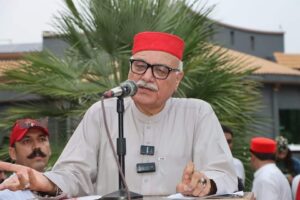

PESHAWAR — Khyber Pakhtunkhwa Chief Minister Sohail Khan Afridi recently took a hardline stance against his critics, aggressively dismissing corruption allegations against his administration and ordering legal action against those peddling unverified claims.
For any sitting government, drawing a line against baseless political propaganda and defending institutional integrity is a standard play. However, the KP accountability test has now truly begun. The Chief Minister’s open challenge—inviting anyone with concrete evidence of corruption to come forward—signals confidence and a commitment to transparency.
Yet, in the court of public opinion, a grand gesture of denial is merely the opening argument. The true test lies in the systemic actions that follow.
The Burden of Proof Belongs to the State
The provincial administration cannot afford to treat these allegations as a mere public relations crisis. The public remains highly sensitive to systemic bribery, the entrenched “commission culture,” and administrative irregularities that have plagued local governance for decades.
A fundamental flaw in the government’s current counter-narrative is the assumption that the burden of proof rests entirely on citizens or political rivals. It does not. The primary responsibility to detect, investigate, and root out malpractice belongs to state institutions.
Khyber Pakhtunkhwa already possesses a multi-layered oversight framework, including:
- The Anti-Corruption Establishment (ACE)
- Internal departmental audit boards
- Provincial inspection teams
To pass the KP accountability test, the leadership must activate these existing state organs to conduct thorough, impartial internal reviews. Investigating departments that have already raised internal red flags would validate the government’s stance far more effectively than public broadsides.
Transitioning from Denial to Decisive Outcomes
To transform political rhetoric into a credible narrative of clean governance, the provincial leadership must adopt a structured approach to institutional reform.
| Core Governance Challenge | Required Institutional Response |
| Countering Political Propaganda | Publishing transparent, public-facing inquiry reports |
| Dismantling “Commission Culture” | Transitioning to mandatory digital procurement and automated contract awards |
| Overcoming Public Cynicism | Initiating independent, third-party performance audits of high-budget sectors |
“An effective and indiscriminate crackdown on administrative irregularities will naturally silence irresponsible political claims, proving that transparency is a governance priority rather than a mere political slogan.”
Conclusion: A Decisive Moment for the Leadership
Ultimately, the Khyber Pakhtunkhwa government stands at a crossroads. The coming weeks will reveal whether the Chief Minister’s public confidence translates into measurable institutional scrutiny.
Dismissing accusations or demanding external proof is an insufficient defense in a fragile economic climate. True victory in the KP accountability test will not be achieved by winning a media war; it will be earned by embedding the principles of merit, equity, and clean governance into the very fabric of the province’s administrative culture.