
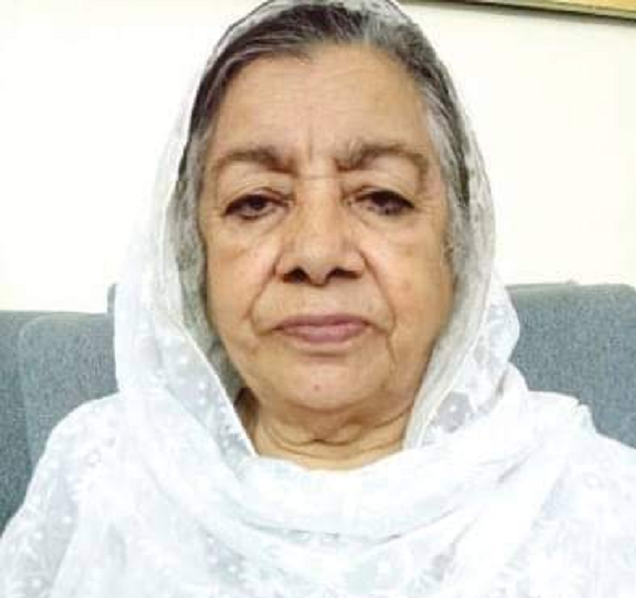
PESHAWAR—In 1958, a young woman from Safaid Dheri, a village on the outskirts of Peshawar, published a short story titled “Hindara”—The Mirror. It was an unassuming title for what would become a lifetime of creative disruption. Through that narrative, and the decades of fiction that followed, Pashto fiction writer Zaitoon Bano did not offer a passive reflection of her society; instead, she used her pen to expose the deep fissures running through it.
Long before modern digital campaigns, Bano spent over half a century documenting the internal lives, systemic oppressions, and quiet resistances of Pashtun women, earning her place as the undisputed “First Lady of Pashto Fiction.”
Also Read: Qamar Gula: A voice that Bridged Hearts Across Borders
Born in 1938, Bano inherited a rich literary lineage as the granddaughter of the celebrated Pashto poet Pir Syed Abdul Quddus Tandar. Yet, for a woman coming of age in a deeply conservative era, transforming a literary inheritance into a public career required immense resilience. She pursued her education against the grain of social expectations, eventually securing Master’s degrees in both Urdu and Pashto from Islamia College University. This bilingual mastery allowed her to bridge regional cultural realities with a broader national discourse.
Bano recognized early on that challenging entrenched societal norms required commanding the platforms of mass media. She stepped into the male-dominated world of mid-century broadcasting, establishing herself first as a producer for Radio Pakistan and later becoming a prominent voice on Pakistan Television (PTV). Her personal life mirrored this intellectual grit; in 1962, she married the noted poet, journalist, and editor Taj Saeed, forming a collaborative partnership that remained central to Peshawar’s literary circles for decades.
Also Read: Women Empowerment: A Key To Sustainable Progress
It was through her creative prose, however, that the fearless Pashto fiction writer Zaitoon Bano staged her most radical critiques. Her stories bypassed romanticized folklore to confront the raw, unvarnished realities of patriarchal control. Her narratives focused sharply on structural injustices:
- The systemic denial of female education within conservative rural enclaves.
- The trauma of forced marriages where women were treated as currency for family alliances.
- The widespread withholding of legal inheritance rights from daughters.
In collections like “Maat Bangri” (Broken Bangles) and her poignant novel “Barg-e-Arzoo” (The Leaf of Desire), Bano captured the emotional toll of societal restrictions without falling into melodrama. Her writing was sparse, sharp, and deliberate. Recognizing the power of visual media, she adapted “Barg-e-Arzoo” into a prime-time PTV Urdu drama serial, bringing uncomfortable conversations about women’s autonomy directly into Pakistani households. Her later drama serial, “Kachkol,” similarly subverted mainstream entertainment by placing complex feminist issues at the center of the screen.
Also Read: Lakki Marwat’s Malaika Noor wins laurels in judo
The institutional recognition of her work reflects the weight of her contribution. Over her career, Bano received 15 national literary awards, including the Pride of Performance and the Fakhr-e-Peshawar award. In 2012, an international panel observing the United Nations Sustainable Development Goals (SDGs) formally recognized her lifelong advocacy on International Women’s Day, cementing her legacy as a regional icon of social reform.
When Pashto fiction writer Zaitoon Bano passed away on September 14, 2021, after a prolonged illness, she left behind an expansive literary archive spanning from 1958 to 2017. Her work remains a foundational text for understanding the intersection of gender, language, and social justice in Pakistan—a legacy that continues to challenge, provoke, and inspire.