
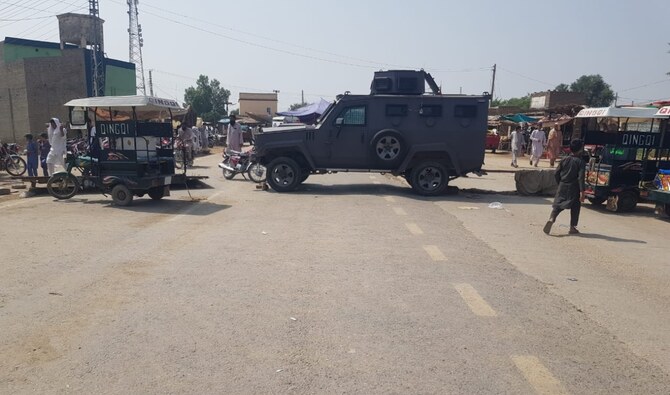
PESHAWAR—The alarming escalation of militant attacks in Lakki Marwat has quietly turned this pocket of northwestern Pakistan into a graveyard for law enforcement, as the latest assault on a Tuesday left nine bodies in its wake. Among the dead were two local police officers—the latest casualties in a relentless, low-intensity war.
For the residents of Lakki Marwat, the violence is a grimly familiar rhythm. Yet, beneath the numbness of daily survival, local communities are grappling with a terrifying reality: a dramatic surge in militant attacks has officially turned their home into the worst-affected hotspot in the entire region.
Also Read: Armed clashes in Lakki Marwat as police, locals crush militanta
The Historical Roots of a Modern Insurgency
The roots of the current crisis run deep, back to a time before the headlines shifted elsewhere. In 2010, the district witnessed one of the country’s single bloodiest atrocities when a suicide bomber drove an explosive-laden truck into a crowded village volleyball match. The blast tore through the spectators, killing more than 100 people and shattering the community’s sense of safety for a generation.
While that attack felt like an isolated peak of horror, the current wave of violence operates like a slow, deliberate chokehold. The modern escalation dates back to late 2022, when the Tehreek-e-Taliban Pakistan (TTP), or Pakistani Taliban, unilaterally tore up a fragile ceasefire agreement with the central government. What followed was an immediate, calculated targeting of the state’s weakest peripheries.
Also Read: Lakki Marwat Blast: 9 Killed, Including 2 Policemen, in Serai Naurang Explosion
The Exploding Timeline of Militant Attacks in Lakki Marwa
Data compiled by the Pakistan Institute for Conflict and Security Studies (PICSS) charts a terrifyingly steep trajectory of destabilization. The exponential rise in violence highlights how rapidly the security situation deteriorated over a four-year period:
- 2022: 14 recorded incidents.
- 2023: 39 recorded incidents (nearly tripling in a single year).
- 2024: 54 recorded incidents.
- 2025: 117 recorded incidents.
Ultimately, this data proves that militant attacks in Lakki Marwat exploded by more than 700% between 2022 and 2025, cementing the district’s status as ground zero for the region’s insurgency.
Also Read: Lakki Marwat’s Malaika Noor wins laurels in judo
A Vacuum of State Power and Tactical Geography
To understand why this region has borne the brunt of this onslaught, one must look beyond the ideology of the insurgents and examine the systemic failures of the state. Security analysts paint a picture of an area deeply abandoned by the center—suffering from crumbling infrastructure, under-resourced and outnumbered police forces, and a hollowed-out administrative presence.
In the eyes of insurgent strategists, these governance deficits transform the district into an irresistible “soft target.” Where the state recedes, the shadow of militancy advances.
Furthermore, geography acts as the insurgent’s greatest ally here. Lakki Marwat sits precariously close to the volatile, semi-autonomous landscapes of the former tribal districts while simultaneously bordering Punjab’s Mianwali district.
Also Read: Policemen protest in Lakki Marwat after deadly attack on police vehicle
Consequently, this specific geographic positioning creates a perfect tactical corridor. Armed groups move fluidly across provincial lines, launching hit-and-run ambushes on police checkpoints before melting back into the rugged terrain, safely out of reach of disjointed law enforcement jurisdictions.
The Path to Restoring Peace
For the people living in the crosshairs, the statistics offer cold comfort. The relentless tide of ambushes, roadside bombs, and targeted assassinations has effectively paralyzed local development and left communities isolated.
Restoring even a semblance of normalcy and halting militant attacks in Lakki Marwat will require more than just short-term military operations. Independent observers warn that unless Islamabad commits to a massive, long-term overhaul—flooding the district with administrative resources, strengthening local police protection, and building vital infrastructure—the state will continue to cede ground, leaving Lakki Marwat to bleed on the margins.