
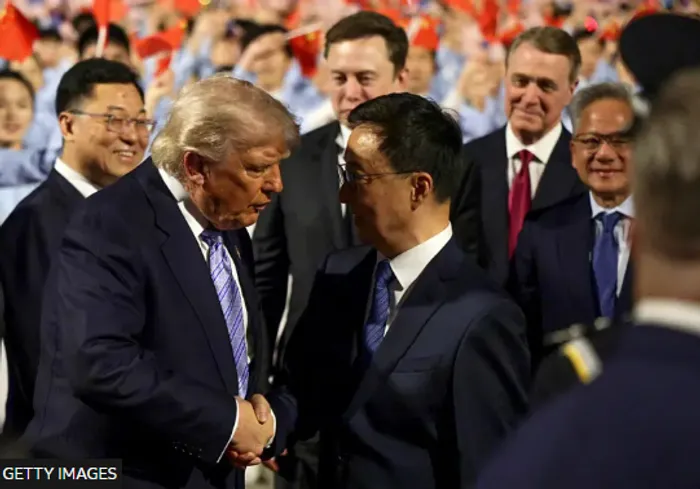
Islamabad – In what is being described as a high-stakes power show of international politics, Donald Trump has arrived in Beijing accompanied by a historic assembly of corporate titans. This isn’t a mere diplomatic visit; Trump’s $1 trillion billionaire delegation to China represents a massive bargaining effort to reshape the future of technology, AI supremacy, and global supply chains.
The Trillion-Dollar Power Show
The scale of the delegation is unprecedented. Leading the group is Tesla CEO Elon Musk, whose net worth exceeds $650 billion, alongside Nvidia’s Jensen Huang, whose wealth is approximately $183 billion.
The delegation also features a “who’s who” of American industry leaders, including:
- Tim Cook (Apple)
- Larry Fink (BlackRock)
- Stephen Schwarzman (Blackstone)
- Kelly Ortberg (Boeing)
- David Solomon (Goldman Sachs)
- Jane Fraser (Citi Group)
- Cristiano Amon (Qualcomm)
- Sanjay Mehrotra (Micron)
Before departing, Trump took to social media to set the tone, stating: “I will ask Xi Jinping to open China’s doors further.”
Specific Demands: Beyond 2017 Commercialism
According to analysis from Reuters, this summit differs from the 2017 visit. Rather than a broad commercial show, Trump’s $1 trillion billionaire delegation to China is focused on solving specific, high-level corporate hurdles. Each CEO has arrived with a clear list of demands ranging from regulatory approvals to the removal of sanctions.
Tech and AI Supremacy
For Elon Musk, the stakes involve securing Beijing’s approval to expand Tesla’s “Full Self-Driving” (FSD) system within China. Additionally, Tesla is looking to secure $2.9 billion worth of materials for solar panel manufacturing from Chinese suppliers—a deal currently threatened by potential Chinese export restrictions on solar equipment.
Jensen Huang of Nvidia views the trip as a critical opportunity to sell advanced AI chips to the Chinese market. Currently, Nvidia faces a complex web of sanctions and approval requirements from both Washington and Beijing.
Aviation and Finance
Bloomberg reports that Boeing is on the verge of finalizing a massive deal for 500 Boeing 737 Max aircraft. In the financial sector, Mastercard and Visa are pushing for a deeper foothold in China’s payment market, with Mastercard seeking larger shares in joint ventures and Visa aiming for 100% ownership in future licenses. Citi Group and Goldman Sachs are likewise seeking expanded market access.
Navigating Sanctions and Investigations
The trip is not without friction. BlackRock’s Larry Fink arrives while his consortium faces a rigorous investigation regarding a $23 billion port deal near the Panama Canal. Meanwhile, the biotech firm Illumina is using the summit to stabilize its business after being hit by Chinese sanctions.
The Bargaining Table of Superpowers
The message from the United States is clear: If China wants to remain an attractive destination for global investment, it must prove itself to be a reliable trading partner.
Conversely, Beijing’s priorities include:
- Encouraging continued American investment in technology and manufacturing.
- Maintaining control over strategic domestic industries and supply chains.
- Negotiating a reduction in U.S. sanctions on AI chips and high-end technology.
While it appears to be a diplomatic summit on the surface, Trump’s $1 trillion billionaire delegation to China has effectively turned Beijing into a bargaining table where the world’s two largest powers are negotiating the next century of commercial and technological dominance.