
PESHAWAR — Governor Khyber Pakhtunkhwa Faisal Karim Kundi called for dialogue to become the primary mechanism for conflict resolution on Friday, emphasizing that mediation and Alternative Dispute Resolution (ADR) are essential for expanding access to justice and promoting social harmony.
Speaking as the chief guest at the closing ceremony of a two-day foundation training program on mediation in Peshawar, Governor Kundi underscored that structured resolution frameworks hold immense significance for the merged and southern districts of Khyber Pakhtunkhwa, where formal legal infrastructure can face geographical constraints.
The specialized training program was organized by the International Mediation and Arbitration Centre (IMAC), an initiative of the Ministry of Law and Justice, at the National Institute of Public Administration (NIPA).
S Climate Change Threats in KP: Governor Kundi Urges Unified Action
Mediation as a Tool of Regional Statecraft and Diplomacy
During his address, Governor Kundi extended his praise to the Ministry of Law and Justice and Federal Law Minister Senator Azam Nazeer Tarar for extending ADR capacity-building initiatives to the province. Significantly, the governor contextualized the domestic necessity of mediation by linking it to Pakistan’s recent high-profile foreign policy achievements.
“Mediation extends beyond courts and communities; it also serves as a powerful tool of diplomacy and statecraft,” Governor Kundi stated.
He cited Pakistan’s recent mediation role in facilitating the historic peace dialogue between the United States and Iran under the leadership of Prime Minister Shehbaz Sharif and Field Marshal Syed Asim Munir as a prime example of how structured, principled engagement can resolve complex geopolitical frictions.
Turning to provincial dynamics, Governor Kundi noted that structured mediation seamlessly complements Khyber Pakhtunkhwa’s traditional jirga system. By integrating modern ADR, the state can provide a dispute resolution framework that respects local culture while remaining fully consistent with constitutional principles, procedural fairness, and legally enforceable outcomes.
IMAC and NIPA Sign Milestone Strategic Accord
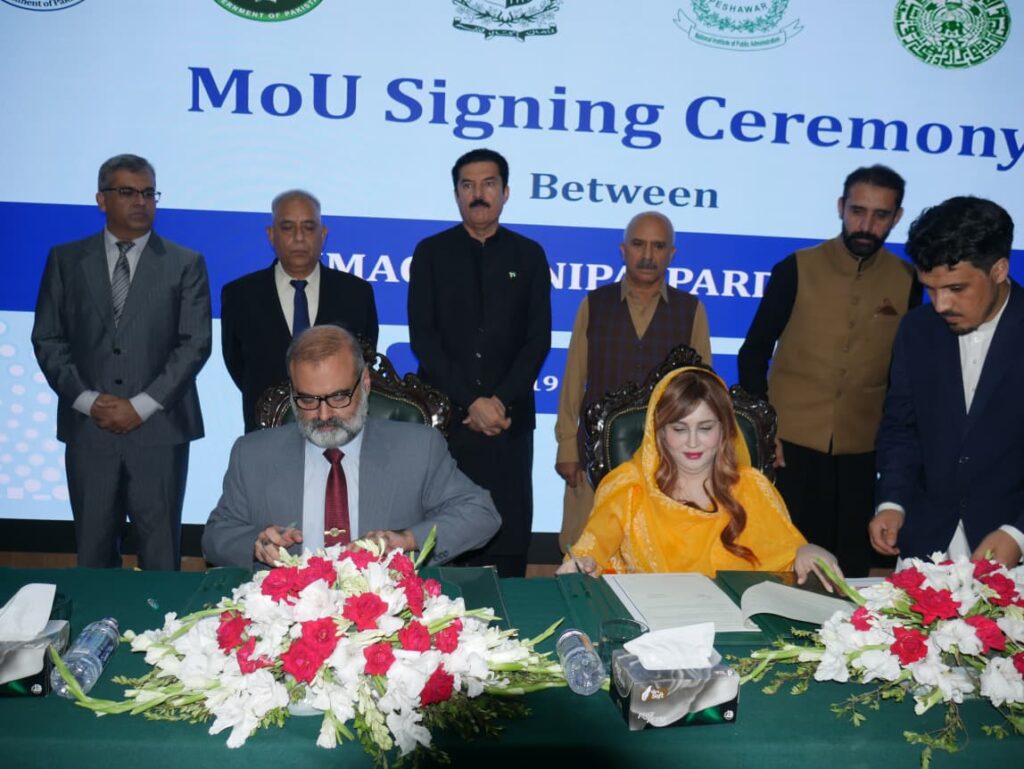
To institutionalize these efforts, a landmark Memorandum of Understanding (MoU) was signed during the ceremony to formalize long-term collaboration in mediation training, ADR research, and public sector capacity building.
The accord was signed by Ms. Aisha Rasool, Senior Consultant at the Ministry of Law and Justice and Project Director of IMAC, and Capt. (Retd.) Usman Gul, Director General of NIPA, PARD, and PPSA.
Capt. (Retd.) Usman Gul noted that integrating ADR into public administration serves as an effective governance tool to rebuild public trust and lower conflict indices, particularly in vulnerable border regions. Furthermore, Lead Trainer Dr. Syed Ata-ur-Rehman highlighted that under the Khyber Pakhtunkhwa ADR Act of 2020, the provincial administration bears a legal responsibility to arrange appropriate capacity-building qualifications for accredited mediators, known locally as Saliseen.
IMAC Expands Local and International Footprint
Detailing the institutional progress of the mediation center, Project Director Aisha Rasool shared that the training program was executed upon the direct advice and encouragement of Governor Kundi.
As Pakistan’s premier institution for arbitration, IMAC has achieved significant operational scale over the past year:
- Professional Training: Successfully trained over 1,400 judges, lawyers, civil servants, and academics.
- Accreditation Ecosystem: Facilitated the formal accreditation and official notification of 247 mediators and mediation centers across the country.
- Global Reach: Expanded Pakistan’s international diplomatic footprint by hosting joint ADR training modules involving professional participants from China, Türkiye, Azerbaijan, and Bangladesh.
The administrative event concluded with Governor Kundi distributing official certificates of completion to the participants, who called for a sustained expansion of standardized ADR programs across the province’s judicial landscape.