
PESHAWAR — The political landscape of the Islamic Republic of Pakistan has long been a theater of the absurd, but nowhere is the drama more poignant—or more perilous—than in Khyber Pakhtunkhwa (KP). As the province grapples with a staggering surge in militancy, the governance structure remains paralyzed by a profound KP security crisis and political deadlock. While blood spills in the valleys of Tirah, the power corridors in Peshawar and Islamabad are occupied by a bitter war of egos and conflicting mandates.
A House Divided by Sacrifice
In a move that surprised many observers, the Pakistan Tehreek-e-Insaaf (PTI) recently displayed a rare streak of parliamentary altruism by nominating Mehmood Khan Achakzai as the Leader of the Opposition. Paradoxically, this “sacrifice” has left the party technically deprived of key parliamentary leadership roles in both the National Assembly and the Senate.
Furthermore, despite Achakzai’s olive branch to the federal government, the KP provincial government remains adamant. The opposition in the KP Assembly has urged Chief Minister Sohail Afridi to set aside personal ego and contact the Prime Minister via telephone to coordinate on peace. However, this suggestion was flatly rejected. The irony remains sharp: Achakzai, who now signals a conditional alliance with the government, was once among those who voted to oust the PTI’s founding chairman from the Prime Minister’s office.
The Tirah Contradiction
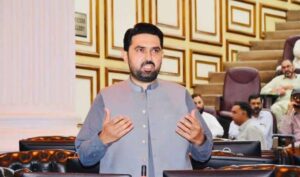
The current KP security crisis and political deadlock is most visible in the provincial cabinet’s recent decision to approve the end of the “Action in Aid of Civil Power Ordinance.” This legal shift effectively strips the administration of specific operational powers. In the subsequent assembly debates, two government members argued that stopping terrorists is not the province’s job, but rather the sole responsibility of security agencies.
This leads to a troubling set of questions from the public. Why does 90% of Pakistan’s terrorism occur in KP? In a bizarre rhetorical turn, some ask why militants do not target “dens of vice” or nightclubs elsewhere, focusing instead on this specific region.
Meanwhile, Provincial Law Minister Aftab Alam has been vocal in stating that the provincial government has not—and will not—authorize the Tirah operation. Conversely, Governor Faisal Karim Kundi maintains that security is a shared federal and provincial responsibility. He claims the provincial government’s opposition to the Tirah operation exists only in the media, noting that the province has already allocated funds for displaced persons—an act that implicitly acknowledges the operation’s reality.
Ego vs. Public Interest
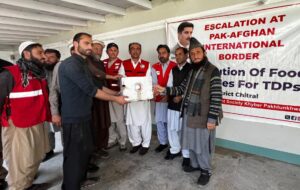
The tragedy of the KP security crisis and political deadlock lies in the disconnect between rhetoric and the ground reality. Chief Minister Gandapur frequently visits the displaced families of Tirah, which is a commendable gesture. Yet, despite these visits and his subsequent orders, the hardships of the victims show no sign of abating.
Whether the provincial government “permits” the operation or not, the humanitarian duty to support the victims should be beyond dispute. Yet, the assembly debates offer no concrete, effective steps for peace. Instead, the strategy appears to be a blame game: shifting the burden of peace to the Federation while simultaneously opposing the operations that aim to achieve it.
A Nation at Odds
Historically, during short-lived wars with India, the Pakistani nation stood as a monolith, supporting the armed forces even on the front lines. Today, that unity has fractured. We hear accusations flying back and forth: some ask why militants don’t target PTI leaders, while others counter with questions about why they don’t strike targets outside the province.
Ultimately, this finger-pointing suggests that we are no longer behaving as a unified nation against a common enemy. The elimination of “Fitna al-Khawarij” and terrorism should be an issue of absolute consensus. While procedural disagreements are healthy, the gravity of the situation demands that laws be adapted and political grievances be sidelined.
If resolving the KP security crisis and political deadlock requires sacrificing political ego for the greater national interest, there should be no hesitation. The people of Khyber Pakhtunkhwa, who bear the brunt of 90% of the nation’s terror, deserve a government—both provincial and federal—that prioritizes their lives over political survival.