

PESHAWAR – The President of the Sarhad Chamber of Commerce and Industry (SCCI), Junaid Altaf, has issued an urgent plea to the federal government to address the escalating Pak-Afghan border trade crisis. He warned that the continued closure of key crossing points has left more than 10,000 transit trade containers stranded at Karachi Port, threatening the livelihoods of thousands.
Also Read: Border closure cripples traders, hits agricultural exports
Billions in Financial Losses
During a press briefing, President Junaid Altaf highlighted that the trade gridlock at Torkham, Ghulam Khan, Kharlachi, and Spin Boldak has caused “irreparable damage” to the economy. With containers stuck for weeks, the financial burden on the business community has reached billions of rupees.
The Crisis by the Numbers:
- Stranded Cargo: 11,000 to 12,000 containers currently stuck at Karachi Port.
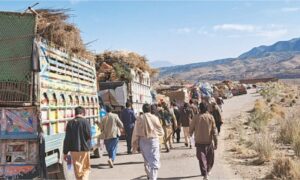
- Perishable Goods: Thousands of trucks carrying food items are stationary at border points; much of the cargo has already perished.
- Daily Penalties: Traders are forced to pay exorbitant demurrage and detention charges daily, which many can no longer afford.
Also Read: Pakistan Afghanistan conflict: is the region on the brink of war?
Calls for Immediate Policy Intervention
The SCCI leadership emphasized that the border shutdown is not only hurting bilateral trade with Afghanistan but is also severing Pakistan’s connection to Central Asian Republics (CARs).
To mitigate the disaster, the SCCI has proposed the following:
- Emergency Clearance: An immediate “one-time clearance” for all cargo currently pending at Karachi Port.
- Fee Waivers: A complete waiver of demurrage and detention charges for the period of the border closure.
- Sustainable Border Management: A call for consistent policies that keep trade routes open despite political or security tensions.
“The uncertainty is more damaging than the cost itself,” stated Junaid Altaf. “If the borders remain closed, we risk permanently losing these trade routes to regional competitors.”
Impact on Regional Stability
Experts warn that the Pak-Afghan border trade crisis is expanding beyond a commercial issue into a social one, as border communities—whose livelihoods depend entirely on cross-border movement—bear the brunt of the shutdown. The SCCI urges the government to prioritize economic connectivity to ensure regional stability.