
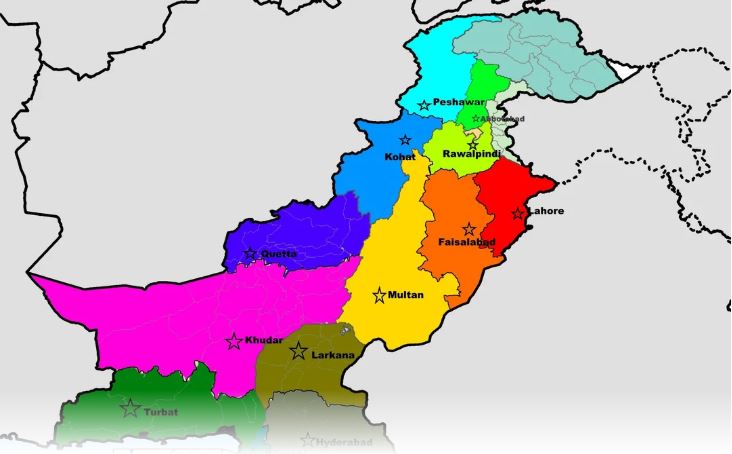
PESHAWAR: The debate over creating new provinces in Pakistan has once again surfaced, reviving old arguments about governance, equity, and federalism. Supporters of the idea claim that smaller provinces or administrative units could help fix systemic failures, making government more responsive and efficient.
Earlier this month, a policy think tank in Islamabad hosted a seminar to examine the feasibility of new provinces. The discussion recalled the late scholar G.W. Choudhury’s observation in his book Constitutional Development in Pakistan, where he described the country as a “constitutional laboratory.” Decades later, that metaphor still holds true.
Also Read: KP Bans Paper Use in Offices From 30 Nov
Federalism, centralisation, and constitutional evolution
Pakistan’s history is filled with repeated suspensions, abrogations, and amendments of constitutions that weakened its federal structure. Instead of deepening federalism, centralisation has often prevailed. At times, this happened through the civil bureaucracy’s “doctrine of parity,” and later through the controversial One Unit Scheme. Both experiments had devastating consequences, leading to the breakup of the country.
The 1973 Constitution, adopted through consensus, sought to correct these wrongs. The subsequent 18th Amendment further strengthened provincial autonomy. The Constitution’s strength lies in its ability to bind Pakistan’s cultural and linguistic diversity within a federal framework. It clearly outlines legislative, administrative, and fiscal powers between the federation and the provinces. Only subjects in the Federal Legislative List belong to the centre.
Through long political struggle, Pakistan achieved consensus on fiscal federalism under Article 160. This established the National Finance Commission (NFC) to ensure fair distribution of financial resources. But demographic and economic shifts have created pressure to review the NFC formula.
At the 11th NFC Award Workshop in Peshawar in October 2025, Khyber Pakhtunkhwa’s Advisor on Finance, Muzammil Aslam, proposed a review. He said the current formula benefits larger provinces because population weight carries 82 percent importance. Smaller and less developed regions, he argued, remain at a disadvantage.
His recommendations included reducing population weight and recognising forests as a new criterion, since Khyber Pakhtunkhwa holds 45 percent of Pakistan’s forests. He also proposed adding development indicators to help less-developed regions catch up with wealthier ones. Performance-based transfers, he said, should reward progress in education, health, and environmental outcomes.
Also Read: Who Benefits From Government Incentives and Relief Packages?
Governance or geography — the real question
Muzammil Aslam also called for the full fiscal integration of the merged tribal districts, formerly FATA, into the provincial financial system. He suggested that even non-NFC funds, such as the Benazir Income Support Programme (BISP), be distributed through a transparent and agreed formula. He said delaying the 11th NFC Award would waste a rare chance to correct past fiscal imbalances.
While the debate around new provinces in Pakistan continues under the banner of administrative reform, the author of the paper argued that creating new provinces brings serious political, financial, and constitutional challenges. Redrawing internal boundaries could inflame ethnic and linguistic tensions, damaging the consensus achieved in the 1973 Constitution.
No detailed cost analysis has ever been made. Each new province would require its own legislature, bureaucracy, police, judiciary, and full administrative system. That would place extra burden on an economy already under strain.
A more practical solution, the author argued, lies in empowering divisions, districts, and local governments. Article 140-A of the Constitution directs that elected local governments must receive political, administrative, and fiscal authority. Implementing this article could strengthen representation and accountability without redrawing borders.
Opposing the idea of dismantling existing provinces, the author emphasised that enforcing constitutional provisions is the only way forward. Article 149, if applied, can maintain harmony between the federation and the provinces while addressing local issues more effectively.
The real issue, the author concluded, is not geography but governance. Pakistan does not need more provinces; it needs empowered citizens and accountable institutions. The country’s stability and progress will come not from new maps but from strong institutions, fair fiscal policies, and effective governance.
(This article is translated from Daily Aaj and written by Dr Syed Akhtar Ali Shah, a former Secretary for Home and Tribal Affairs and retired Inspector General of Police.)