
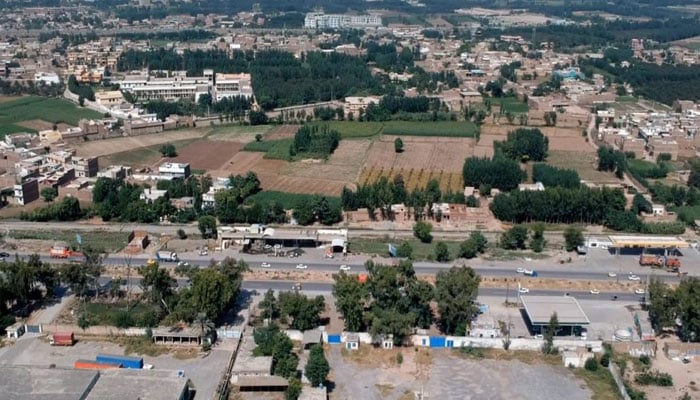
The agricultural lands in Khyber Pakhtunkhwa (KP) are rapidly being choked by a relentless sprawl of housing schemes. What was once fertile soil, essential for the province’s food security, is being systematically replaced by “concrete jungles.”
While the government continues to compile reports on the rising trend of converting agricultural land into residential colonies, critics argue that these documents are a mere “smokescreen” for a deep-rooted nexus of corruption and administrative complicity.
Also Read: Over 90% of housing societies in KP are illegal or unregistered
Despite repeated warnings, the trend persists, suggesting that the destruction of the province’s agricultural base is being executed with the direct or indirect involvement of those meant to protect it.
A Statistical Disaster: The Vanishing Greenery
The sheer scale of unauthorized construction reveals a staggering disregard for urban planning and environmental laws. Data suggests that the provincial capital and surrounding districts are the hardest hit by the housing “mafia.”
| District | Total Housing Societies | Illegal Societies | Built on Agricultural Land |
| Peshawar | 156 | 116 | 81 |
| Mardan | 135 | 41 | 27 |
| Charsadda | — | 71 | (Significant portions) |
| Kohat | — | 14 | (Significant portions) |
In Peshawar alone, a massive 116 out of 156 societies are illegal, with 81 projects directly occupying prime agricultural land. This pattern repeats in Mardan, where 41 of the 135 societies are unauthorized, and in Charsadda and Kohat, where dozens of illegal schemes continue to shrink the available farming acreage.
Also Read: Khyber Pakhtunkhwa’s Agricultural Lands Under Threat as Housing Societies Flourish
The Power of the “Mafia” and Administrative “Helplessness”
The housing and builders’ mafia exploits the desperate demand for housing by trampling over municipal and environmental regulations. These developers frequently ignore building maps, bypass encroachment laws, and place an unbearable burden on urban infrastructure without a second thought.
However, the primary reason for this unchecked expansion is not just simple corruption; it is a calculated “helplessness” within the bureaucracy. High-ranking individuals within the government and the civil service are often direct or indirect stakeholders in these lucrative housing schemes.
“When those responsible for decision-making and law enforcement are partners with the mafia, expecting an average official to take action is futile. In such a system, a few coins are enough to settle the matter and bury the files.”
The immense profits generated by this sector have turned the provincial capital into a commodity. The influx of “black money” into real estate has reached a point where it feels as though the city itself has been put up for sale.
A Future Without Food
Khyber Pakhtunkhwa’s agricultural land is already insufficient to meet the food requirements of its population. The current trajectory, seen in Peshawar, Nowshera, Mardan, Charsadda, Swabi, Kohat, and Bannu, suggests a total collapse of the rural ecosystem.
It is not just large-scale schemes at fault; the constant fragmentation of ancestral lands for small-scale commercial and residential use is compounding the crisis. If this remains unchecked, the province will soon have nothing left but a series of interconnected shopping centers and housing blocks, with no land left to grow food.
The Way Forward: Transparency and Planning
The government bears the ultimate responsibility for this crisis due to its failure to provide planned residential alternatives. The lack of government-led housing on non-agricultural (barren) land has forced the population into the arms of illegal developers.
To rectify this, the following steps are essential:
- Government-Led Housing: The state must initiate official, planned housing schemes at every district headquarter, specifically targeting non-agricultural land.
- Zero Tolerance for Illegality: Authorities must stop the “report-writing” cycle and move toward physical enforcement against unregistered societies.
- Systemic Transparency: The process of land acquisition, development, and sale must be made transparent to eliminate the influence of powerful “middlemen” and corrupt officials.
The survival of the province depends on a shift from profit-driven chaos to sustainable, state-regulated urban development.