
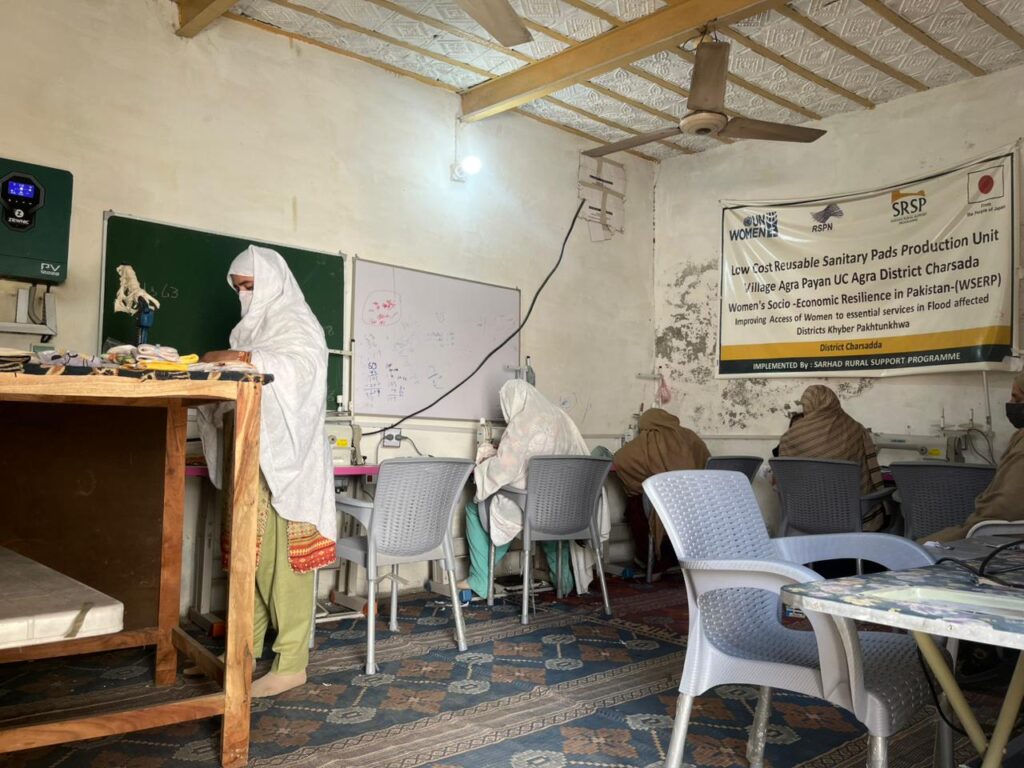
In a remarkable effort to tackle menstrual hygiene challenges faced by women in her community, Neelam Bibi, a resident of Charsadda, has set up a small-scale production center at her home where she and a team of local women produce affordable, reusable, and high-quality sanitary pads.
Her work has become a powerful example of women empowerment and community-driven health solutions in rural Khyber Pakhtunkhwa.
Forty-year-old Neelam Bibi, along with five other women, handcrafts sanitary pads that she says can be used for up to a year — making them a reliable option for women who cannot afford commercial hygiene products.
Speaking to Peshawar Post, Neelam explained that her idea emerged during the devastating floods of 2022, when thousands of families in Charsadda were displaced. Many women struggled to manage their menstrual hygiene due to the lack of access to sanitary pads.
“During that time, we tried to help the women by providing them with clean cloths,” Neelam recalled. “Later, a non-governmental organization provided us with hygiene kits, which we distributed among the affected women. That experience made me realize how essential it was to make sanitary pads locally available at low cost.”
After receiving training, Neelam began producing reusable sanitary pads at home. What started as a small initiative has now grown into a source of comfort, dignity, and empowerment for hundreds of women across Charsadda. Over the past three years, she and her team have produced thousands of sanitary pads, making menstrual hygiene more accessible in the region.
For the women working alongside her, the initiative provides both a vital health resource and a sustainable income stream.
“Talking about menstruation used to be considered taboo in our community,” one of the workers shared. “But now, even the men in our families are proud that we’re contributing to household income and helping other women meet their basic needs.”
Neelam now hopes to expand her project to reach more women across rural Khyber Pakhtunkhwa, aiming to ensure that no woman has to compromise her health due to social stigma, financial barriers, or the lack of menstrual hygiene products.
—